.
Finite Element Analysis (FEA) is a Computational Method used to Predict Structural Integrity
Finite Element Analysis (FEA) Services to Ensure Equipment Structural Integrity, Safety and Reliability. FEA is a Powerful Computational Method used to Predict how Products React to Real-world Forces, Vibration, Heat, and other Physical Effects.
(Stress, Thermal, Vibration and Fatigue) Finite Element Analysis is performed on equipment including pressure vessels, heat exchangers, skids and other power / process / manufacturing components.
The Benefits of Performing FEA Analysis includes:
- Creating a Stronger, Safer Product – Locates Weaknesses and Creates a Stronger Design
- Reducing Unneeded Material – Low Stress Areas Add Needless Weight & Cost to the Part
- Determining the Strength of a Part – Predicts under what Conditions an Object will Fail and whether it will Meet Code
O’Donnell Consulting performs both design/ analysis of new equipment and analysis of operating equipment to codes including AWS, API, and ASME. We have 30 + years experience of all types of FEA challenges – by working closely with your team, we ensure that our analysis aligns with your unique objectives.
Mechanical Engineering
FEA Analysis on Pressure Vessels is Performed by Simulating Various Loading Conditions – Determining Stress and Strain Distributions and Potential Failure Points. This Provides a Comprehensive, Detailed Picture of how the Vessel will Behave. Read the Blog on Pressure Vessel Design.
Our FEA Experience includes Formula One Brake Rotors, Furnaces, Conveyors, PSA Vessels, and Welded/Non-Welded Assemblies Operating in Ambient & Extreme Environments.
See our Portfolio of FEA Projects / Solutions which Span Various Industries including Manufacturing, Energy and Aerospace.
Recent Projects
Types of Finite Element Analysis
- Seismic, Vibration & Fatigue
- Heat Transfer
- Linear/ Nonlinear FEA Analysis
- Fracture Analysis
- Component Life Assessment
- Thermal Cycling & Fatigue
- Thermal / Transient
- Buckling Analysis
- Creep & Creep Fatigue
- Fatigue / Failure Analysis
- Design Verification
- Fabrication Process Evaluation
- Vibration, Shock & Impact
- Crack Propagation
- Elevated Temperature
- Water Hammer
- Computational Fluid Dynamics (CFD)
- Fluid Flow Analyses
- Lifting Lug Analysis
- Torsional / Bending Strain
- Design Optimization
Applications Include:
- Petrochemical
- Transportation
- Aerospace
- Energy
- Military
Partial List of ASME Codes We Reference
B&PV Section VIII Div. 1 (Design & Fabrication of Pressure Vessels)
B&PV Section VIII Div. 2, Part 5 (Design by Analysis)
B&PV Section VIII Div. 3 (Alternative Rules for Construction of High-Pressure Vessels)
B31.1 & B31.3 (Engineering & Operation of Power and Process Piping)
B31.4 (Pipeline Transportation Systems for Liquids & Slurries)
BTH-1 & B30.20 (Below the Hook Lifting Devices)
API 579 / ASME 579-1 Fitness For Service
Give Us a Call to Discuss Your Engineering Challenges
Finite Element Analysis Related Links
>> Tom O’Donnell, PE
>> Description of Finite Element Analysis
>> Vibration & Fatigue Analysis
>> Background of the ASME Code
>> Project: FEA Analysis of Pressure Vessels to ASME Code
>> Portfolio of Finite Element Analysis Projects
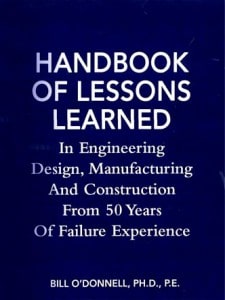
Learn from the experience of others. Especially when one such “other” is Dr. William O’Donnell, PhD, PE, Founder and President of O’Donnell Consulting Engineers, Inc., and ASME “Engineer of the Year” – his 50 years of experience in analysis of components including fatigue and fracture safety evaluations and failure analyses are now comprised in this volume.
If you are interested learning more in Engineering Design, Manufacturing and Construction, as well as Failure Analysis, then this book is a must have!
$49.95*
* Does not include shipping, handling or tax