FEA – Dam GATE
FEA – Conveyor Chain
FEA – Cable Short
Description of Finite Element Analysis
Finite Element Analysis (FEA) is a powerful computational method used to predict how structures and components respond to mechanical loads, thermal conditions, vibration,F and other real-world forces. FEA reveals stress distributions, deformation patterns, and potential failure modes that would be impossible to quantify through hand calculations alone.
For over 30 years, O’Donnell Consulting Engineers has applied FEA to pressure vessels, piping systems, heat exchangers, and industrial equipment — helping clients confirm structural integrity, achieve code compliance, and resolve engineering problems before they become costly failures.
Quick Navigation
- What is FEA?
- Benefits of FEA
- Background of FEA
- Types of Analysis
- Factors of Safety
- Applications of FEA
- How FEA is Performed
- References & Resources
Typical clients include:
- Companies that may have FEA analysis capabilities – but require assistance to meet a deadline.
- Companies that require an independent engineering review or a Fitness-For-Service.
- Manufacturers with clients who require stress, thermal, or vibration analyses to confirm structural integrity and compliance to specific Codes.
- Fabricators and/or owner/operators that wish to perform a failure investigation – determining the root cause, and developing improved, safer designs.
- Plant Owner/operators and their representatives that wish to perform a failure investigation to determine liability.
What is Finite Element Analysis (FEA)?
Finite Element Analysis (FEA) is a computational method that predicts how components and assemblies respond to mechanical forces, thermal loads, and vibration—enabling engineers to identify failure modes and optimize designs before fabrication. The technique works by dividing complex structures into thousands of smaller elements, each representing a portion of the whole system.
Mathematical equations governing stress, strain, heat transfer, or other physical phenomena are solved across all elements simultaneously, revealing how the entire structure behaves under specified conditions. This approach handles geometric complexity, material nonlinearity, and combined loading scenarios that would be impossible to analyze using traditional hand calculations alone.
What are the Benefits of FEA?
- Graphical software tool that displays stresses, strains and displacements
- Pinpoints design deficiencies
- Virtual prototyping
- Efficient and less expensive design cycle – increasing productivity and profit
- Used to quantify stress, vibration, thermal cycling, fatigue, buckling
- Ensures structural integrity per codes such as API & ASME
- Distinguishes between failures due to design deficiencies, materials defects, fabrication errors, and abusive use
- Provides quantified results previously based on metallurgical and mechanical testing
What is the Background of FEA?
Development of FEA began in the 1940s, and by the 1950s it was used by aerospace engineers to design better aircraft structures. Since then, aided by the rapid growth of computing power, the method has continually developed, and is now the tool of choice for analysis by mechanical, civil, biomechanical, and other engineers. Read more about the History of Finite Element Analysis.
What are the Types of FEA Analysis?
Linear FEA – is a computational method used to predict how a structure responds to applied loads, pressures, or temperatures, assuming elastic material behavior and small deformations. Because the relationship between force and displacement remains constant, the analysis is computationally efficient and well-suited for stress analysis of pressure vessels, piping systems, and structural components operating within their elastic range.
Nonlinear FEA – is used when material properties, geometry changes, or contact interactions don’t comply with linear assumptions. Unlike linear FEA, it models relationships where outputs (e.g., stress) aren’t proportional to inputs (e.g., load). Examples include simulating plastic deformation, or creep in high-temperature environments, or simulations where surfaces collide or separate.
Dynamic FEA – evaluates time-dependent loads, including vibrations, impacts, and transient forces. Applications include (1) Modal Analysis, which identifies natural frequencies to avoid resonance in structures like bridges or turbine blades (2) Seismic Response and (3) Shock/Impact Analysis, such as aerospace component durability during launch.
Thermal FEA – simulates heat transfer (conduction, convection, radiation) and its effects on materials and systems. Applications include Electronics Cooling and Thermo-Mechanical Analysis, which predicts thermal stresses in welding processes or high-temperature industrial equipment.
What are Factors of Safety?
Typically, acceptable limits are defined by a factor of safety — the ratio of the allowable stress of the material to the actual stress in the component. If the factor of safety is too small, the possibility of failure becomes unacceptably large; on the other hand, if the factor is unnecessarily large, the result is an uneconomical or nonfunctional design.
For the majority of structural and machine applications, factors of safety are specified by design specifications or codes written by committees of experienced engineers, such as the (ASME) American Society of Mechanical Engineers (codes for pressure vessels, heat exchangers, and other process equipment).
What are the Applications?
FEA applies across virtually every engineering discipline where structural integrity, thermal performance, or dynamic response matters.
- Civil & Structural Engineering
- Aerospace & Defense
- Manufacturing & Industrial Equipment
- Petrochemical & Refining
- Materials & Mining
- Power Generation
How FEA is Performed
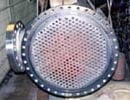
Example – Heat Exchanger.

However, each element interacts with its neighbors, i.e., each element’s response tightly depends on that of its neighbors, and the responses of their neighbors to those of other neighbors, and so forth. For any type of loading, there is a force response on each element. However, element equations cannot be solved alone to render the solution over each element.
Since the Heat Exchanger has Symmetry, only a Slice needs to be Modelled.
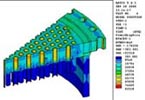
Instead, all the equations from all the elements over the entire structure need to be solved simultaneously. This task can only be performed by computers. It is noteworthy that, as the structure is broken into a larger number of elements, a greater number of simultaneous equations need to be solved. Thus, typically, results for more complex structures require more computing power.
Whenever possible, symmetry is used to minimize model complexity. Typically finer meshes are used in the locations where the highest stress or heat flow may exist, allowing quicker solutions to what would otherwise take longer computation time. Finite element analysis is often used to verify design integrity and identify critical locations on components without having to build the part or assembly – and provides results that define areas of high strains/stresses which may or may not be life-limiting to the component.
Temperature Distribution Model of the Heat Exchanger
References
- “Finite Element Analysis – Theory and Application” S. Moaveni, Prentice Hall, 1999
- “An Introduction to the Finite Element Method” J.N. Reddy, McGraw Hill 1993
- “Building Better Products with Finite Element Analysis” V. Adams & A. Askenazi, Onward Press, 1999
- “Material Modeling in Finite Element Analysis” 2nd Edition Z. Yang, CRC Press, 2024
FEA Related Resources
Summary
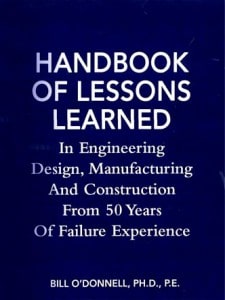
Learn from the experience of others. Especially when one such “other” is Dr. William O’Donnell, PhD, PE, Founder and Chairman of O’Donnell Consulting Engineers, Inc. His 50 years of experience in analysis of components including fatigue and fracture safety evaluations and failure analyses are now comprised in this volume.
If you are interested learning more in Engineering Design, Manufacturing and Construction, as well as Failure Analysis, then this book is a must have!
$49.95*
* Does not include shipping, handling or tax