Performing Finite Element Analysis (FEA) Design & Analysis of Pressure Vessels – Ensuring Integrity, Safety & Reliability
Summary
When standard pressure vessel design rules fall short – complex nozzle configurations, thermal shock loading, or geometries outside ASME Section VIII Division 1 limits – catastrophic failure becomes a real risk. A miscalculation could mean vessel rejection, project delays costing hundreds of thousands, or worse, field failures with liability consequences.
ASME Section VIII Division 1 provides design-by-formula methods (Design by Rule) that work for standard pressure vessel configurations. However, FEA becomes necessary when:
- Complex geometries exceed standard nozzle reinforcement rules
- Thermal shock loading creates stresses that can’t be calculated by hand
- Fatigue evaluation is required per Division 1 Mandatory Appendix 46
- Elevated temperature service requires creep-fatigue analysis
- Non-standard configurations aren’t covered by code formulas
When these conditions exist, ASME requires Design by Analysis using validated finite element methods that comply with Section VIII Division 2, Part 5 requirements. Division 2 explicitly requires protection against Plastic Collapse, Local Failure, Buckling, Fatigue and Ratcheting.
Read More about the differences between Design by Rule and Design by Analysis.
For over 30 years, O’Donnell Consulting has performed finite element analysis of pressure vessels that withstand the scrutiny of authorized inspectors and third-party reviewers. We don’t just run FEA software – we ensure your analysis meets ASME B&PV requirements.
Mechanical Engineering
Fatigue Analysis
Fatigue Analysis is performed per ASME Section III Class 1 and Section VIII Division 2. The fatigue design life evaluation procedures in Section III of the ASME Boiler and Pressure Vessel Code were originally developed in the U.S. Naval Nuclear Program. Those involved were Dr. William O’Donnell, (Bernie) Langer, W.E. (Bill) Cooper and James (Jim) Farr – who, in the late 1950’s and early 1960’s developed the initial formulation of this technology in the Tentative Structural Design Basis for Reactor Pressure Vessels, which became known as “SDB-63.” Section III of the ASME Code “Vessels in Nuclear Service” was the first to include specific Code rules to prevent low cycle fatigue failure.
In addition to developing the O’Donnell-Porowski Solution for elevated temperature design under cyclic thermal and pressure loading – Dr. O’Donnell has also made significant contributions to the ASME Subgroup on Fatigue Strength – and the ASME Subcommittee on Design. He has also written numerous publications on Design, Fatigue, Failure and Creep.
Our Engineers have over 30 years Experience in Finite Element Analysis – Performing Thermal/Transient, Structural, Creep, Vibration, Fatigue and Failure Evaluations. This includes a wide variety of Pressure Vessels in accordance with Section VIII, Division 1 and 2 of the ASME Boiler & Pressure Vessel Code – on Chemical Reactors, Accumulator Tanks, Autoclaves, PSA Vessels and Heat Exchangers. See more of our ASME Design/ Analysis Solutions.
Our Process Involves
-
Initial Consultation & Code Review
We review your design to determine applicable code section, identify analysis requirements, and establish acceptance criteria. -
Geometry Modeling & Mesh Development
Create solid models from your drawings, develop appropriate mesh density based on stress gradients, verify mesh convergence per ASME requirements. -
Load Case Definition
Define all required load combinations: pressure, thermal, dead weight, seismic, wind, nozzle loads, per Division 2 Part 5. -
Analysis Execution
Perform elastic or elastic-plastic analysis as appropriate, extract stresses at critical locations, apply stress linearization procedures. -
Code Compliance Verification
Classify stresses (primary, secondary, peak), compare to allowable limits, document compliance with Section VIII Division 2 criteria. -
Report Delivery
Provide comprehensive analysis report documenting methodology, results, and code compliance for review.
Recent Projects
Experience Includes
- Linear/ Nonlinear FEA Analysis
- Seismic, Vibration & Fatigue
- Heat Transfer
- Fracture Analysis
- Thermal Cycling & Fatigue
- Thermal / Transient
- Buckling Analysis
- Creep & Creep Fatigue
- Fatigue / Failure Analysis
- Design Verification
- Fabrication Process Evaluation
- Vibration, Shock & Impact
- Elevated Temperature
- Computational Fluid Dynamics (CFD)
- Fluid Flow Analysis
- Design Optimization
Applications Include:
- Petrochemical
- Transportation
- Aerospace
- Energy
- Manufacturing
- Oil / Gas
- Military
In Addition to the following ASME Codes – We also Refer to Other Codes including API & AWS
B&PV Section VIII Div. 1 (Design & Fabrication of Pressure Vessels)
B&PV Section VIII Div. 2, Part 5 (Design by Analysis)
B&PV Section VIII Div. 3 (Alternative Rules for Construction of High-Pressure Vessels)
Give Us a Call to Discuss Your Engineering Challenges
Relevant Links
>> Tom O’Donnell, PE
>> FEA Design & Analysis of Chemical Tubular Reactor – To ASME Section VIII Code
>> Blog: Basics of Pressure Vessel Design
>> Blog: Common Mistakes in Pressure Vessel Design & Analysis
>> Blog: Description of Finite Element Analysis
>> Blog: Background of the ASME Code
>> Blog: Overview of ASME B&PV Design by Analysis
>> Blog: Introduction to Fatigue / Failure Analysis
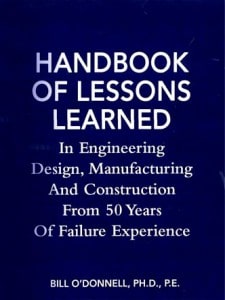
Learn from the experience of others. Especially when one such “other” is Dr. William O’Donnell, PhD, PE, Founder and President of O’Donnell Consulting Engineers, Inc., and ASME “Engineer of the Year” – his 50 years of experience in analysis of components including fatigue and fracture safety evaluations and failure analyses are now comprised in this volume.
If you are interested learning more in Engineering Design, Manufacturing and Construction, as well as Failure Analysis, then this book is a must have!
$49.95*
* Does not include shipping, handling or tax