
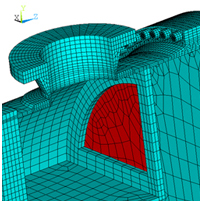
Ensuring Pressure Vessel Design and Analysis meets ASME Code
Pressure vessel design and analysis to ASME B&PV Code Section VIII, Divisions 1, 2, and 3, including nozzles, saddle supports, and other attachments. Analysis covers finite element stress, thermal, seismic, vibration, fatigue, and creep evaluation.
What is ASME Code?
The ASME Boiler and Pressure Vessel (B&PV) Code sets requirements for the design and construction of pressure equipment and is adopted into law by most U.S. states and Canadian provinces. We perform both closed-form Design-By-Rule Methods (ASME Section VIII Division 1) and Design-By-Analysis (ASME Section VIII Division 2) using Finite Element Analysis (FEA).
Why use FEA?
Pressure vessels have wide applications in power plants, as well as the process & chemical industries. Vessels often have openings of various diameters to accommodate manholes, handholds, and nozzles, that develop high stress concentrations which may lead to vessel failure. These geometric discontinuities alter the stress distribution in the neighborhood of discontinuity so that elementary stress equations no longer apply – thus finite element analysis is often needed.
Why Pressure Vessels Fail — and How ASME Analysis Prevents It
Pressure vessel failures are rarely random. They follow predictable patterns — specific failure modes that develop when design, loading conditions, or material behavior exceed what simplified formulas can adequately characterize. This is precisely why ASME Section VIII Division 2 Part 5 exists: to require explicit, rigorous evaluation of each failure mode rather than relying on conservative thickness margins alone.
O’Donnell Consulting brings uncommon depth to this work. Dr. William O’Donnell, Sr. was a principal contributor to the fatigue design procedures now embedded in Division 2 and Section III — the same procedures that define how these failure modes are evaluated today. He has written numerous publications on fatigue operating in elevated temperatures. Understanding not just the code requirements but the engineering judgment behind them is what separates a defensible analysis from one that is formulaic.
The six failure modes are described below — and how each are evaluated:
| Failure Mode | What It Is | Typical Triggers | Analysis Method |
|---|---|---|---|
| Plastic Collapse | Progressive, permanent deformation until the vessel can no longer carry load | Excessive internal pressure; overload conditions; inadequate wall thickness | Elastic or elastic-plastic FEA; limit load analysis per paragraph 5.2 |
| Local Failure | Localized rupture at stress concentrations (nozzles, fillets, support attachments) before global collapse occurs | Triaxial stress states at geometric discontinuities; high local strain demand | Elastic stress analysis (principal stress sum limit) or elastic-plastic strain limit analysis per paragraph 5.3 |
| Buckling | Sudden collapse under compressive or external pressure loading | Vacuum conditions; external pressure; compressive thermal loads; thin-wall vessels | Eigenvalue buckling analysis to find critical modes; elastic-plastic analysis with geometric imperfections per paragraph 5.4 |
| Fatigue | Crack initiation and propagation from cyclic stress | Cyclic pressure; thermal cycling; vibration; startup/shutdown cycles; flow-induced loading | Fatigue screening, then elastic or elastic-plastic fatigue analysis per paragraph 5.5 |
| Ratcheting | Incremental plastic deformation accumulating cycle by cycle until the vessel distorts or fails | Cyclic thermal loads combined with sustained pressure; repeated overloads | Elastic ratcheting limits or elastic-plastic analysis per paragraph 5.5; shakedown verification to confirm strain stabilization |
| Creep Damage | Time-dependent deformation and damage at elevated temperature, leading to stress rupture, creep buckling, or creep ratcheting over the vessel’s design life | Sustained pressure and load at temperatures where time-dependent material properties govern; thermal cycling with hold times at temperature | Stress rupture, creep buckling, and creep ratcheting evaluations, with creep-fatigue screening, per paragraph 5.6 (added in the 2025 Edition). See Elevated Temperature Design & Analysis. |
For vessels where Design by Rule cannot adequately characterize the stress state, Design by Analysis provides a code-defensible result.
Frequently Asked Questions
Do all six failure modes need to be evaluated for every vessel?
Not always by hand calculation, but Division 2 Part 5 requires that each mode — plastic collapse, local failure, buckling, fatigue, and ratcheting — be addressed for the vessel’s actual operating conditions. A vessel under steady, low-cycle service may show fatigue and ratcheting are non-governing quickly; a vessel under vacuum or thermal cycling typically requires a full evaluation of all six in an integrated model.
Why can’t handbook formulas be used at nozzles and other geometric discontinuities?
Elementary stress equations assume smooth, uniform geometry. At nozzles, fillets, and support attachments, stress concentrations create triaxial stress states that those formulas don’t capture. Finite element analysis models the actual geometry and load path, which is why it is used for these locations when the rules do not cover the configuration or when a more accurate evaluation is needed.
What is shakedown, and why does it matter for ratcheting?
Shakedown is the condition where a vessel under cyclic loading stabilizes to elastic behavior after an initial cycle or two of plastic deformation, rather than continuing to deform with each cycle. Division 2 Part 5.5.7 requires shakedown verification to confirm the vessel reaches this stable state — if it doesn’t, ratcheting accumulates cycle by cycle until the vessel distorts or fails.
Examples
- ASME Pressure Vessels
- Process Decanters
- Heat Exchangers
- Cryogenic Vacuum Chambers
- LNG Storage Tanks
- Liquid Oxygen (LOX) Tanks
- Liquid Nitrogen (LIN) Tanks
- Chemical Reactors


Types of Engineering Analysis
- Stress Analysis
- Linear & Non-Linear
- Vibration & Fatigue
- Fitness for Service
- Fracture Analysis
- Design Optimization
- Fabrication Process Evaluation
- Heat Transfer
- Lifting Analysis
- Fatigue Analysis
- Thermal/Transient
- Flow Analysis
- Shock & Impact
- Safety Evaluations
- Elevated Temperature
- Structural Integrity
- Thermal Cycling
- Creep Fatigue
- Creep Ratcheting
- Buckling
ASME Codes We Work To
- Section III Class 1, 2 and 3 Vessels and Components
- B&PV Section VIII Div. 1, 2 and 3 Vessels
- B&PV Sections IX and XI
