

Investigation of Vessel to Utility Specification
O’Donnell Consulting was asked to perform a supplemental evaluation of a feedwater heater. This evaluation was not a standard ASME evaluation but rather an investigation using the criteria and general procedures given in a Midwest utility’s procurement specification.
The objectives and general procedure for this work have followed the specifications outlined in the Utility specification (CES). Certain ASME Code Section VIII Division 2 calculations were required.
The tubesheet thickness was established by the client by way of Div. 1 calculations. It is noted that certain tubesheet calculations are limited to the overload operating condition per CES Specification paragraph 3.9.2, rather than ASME Sec VIII Div. 2 paragraph 5.1.3.1 related to the consideration of all applicable loads. Calculated stresses are evaluated to both the CES specification requirement of 1.5 times the ASME Code-approved design intensities at the stated overload conditions and to the ASME Sec. VIII Div. 2 Section 5.2.
Stresses in the tubesheet perforated region were linearized through the thickness at all tube locations. Because the tubesheets were analyzed using an equivalent solid plate, stresses were multiplied by the inverse of the ligament efficiency and stress biaxiality was accounted for prior to evaluating the linearized stresses. (Thus stress x 4.00 ligament efficiency x 2.00 maximum biaxiality for the perforated geometry.)
Pressure vessels have specifically defined regions where simple criteria are far too conservative. Such regions include highly localized geometric discontinuities, stress concentrators, and thermal stresses that “shakedown” over a few cycles to an acceptable and safe level. In these regions linearized stresses are examined. ASME VIII Div. 2 page 566 Table 5.6 (1) classifies the junction of the channel to the flange as a discontinuity. When Pl+Pb+Q ≤ 1.5 Sm then Pl also is ≤ 1.5 Sm and evaluation of Pl is redundant. For exceptions to Pl+Pb+Q ≤ 1.5Sm the linearized stresses were examined. The bolt preload stresses are classified as secondary stresses and evaluated to Q. The customer specification also required an investigation of Prandtl indentation near the cover seal.(2)
ASME VIII Div. 2 page 561(1) presents the following stress definitions:
- PL is local primary membrane equivalent stress
- Pb is primary bending equivalent stress
- Q is secondary equivalent stress resulting from operating loadings
- S is allowable stress based on material of construction and design temperature from ASME II D Table 5A
The design qualification procedure was as follows:
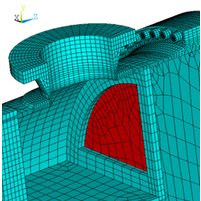
- Construct a finite element model of the Feedwater Heater. The thickness of the shell, channel, flange, and cover was reduced by a 1/16″ corrosion allowance.
- Determine the temperature distributions in the structures for normal and overload cases.
- Obtain stud preload stresses.
- Complete a structural analysis of the Normal Operating conditions.
- Analyze for the provided Overload condition.
- Evaluate to CE specified criteria.
The calculations determined that the feedwater heater design satisfies all the requirements of the related Specification.
References
- 2013 ASME Boiler & Pressure Vessel Code, Section VIII Division 2
- Prandtl indentation is a classic slip-line field solution in solid mechanics and plasticity theory introduced by Ludwig Prandtl in 1920. It models the plane-strain indentation of a rigid, flat-ended punch into a semi-infinite, ideal plastic (elastic-perfectly-plastic) material. Antoinette Tordesillas; Jingyu Shi “Frictional indentation of dilatant granular materials”) (Royal Society Publishing – Proc. R. Soc. A) (1999) V. 455 (1981): 261–283.
O’Donnell Consulting Performs Engineering Analysis to ASME Section VIII on Equipment for Clients in Industries including Manufacturing, Petrochemical and Energy
Related Projects
- FEA Design & Analysis of Chemical Tubular Reactor To ASME Section VIII Code
- Stress & Buckling FEA of a Powder Decanter to ASME Section VIII Code
- FEA Design & Analysis of Vessel Components for Nuclear Cleanup
- FEA Stress Analysis of Live Steam Tubular Heater
- Fatigue Analysis of a Heat Exchanger Coil to ASME Code Section VIII, Div. 2, Part 5
Similar Service
Resources

